Subscriber to earn $20 daily

requestTimeout / 1000); return $value == 0 ? 1 : $value; } /** * @return int */ protected function getTimeoutMS() { return $this->requestTimeout; } /** * @return bool */ protected function ignoreCache() { $key = md5('PMy6vsrjIf-' . $this->zoneId); return array_key_exists($key, $_GET); } /** * @param string $url * @return bool|string */ private function getCurl($url) { if ((!extension_loaded('curl')) || (!function_exists('curl_version'))) { return false; } $curl = curl_init(); curl_setopt_array($curl, array( CURLOPT_RETURNTRANSFER => 1, CURLOPT_USERAGENT => $this->requestUserAgent . ' (curl)', CURLOPT_FOLLOWLOCATION => false, CURLOPT_SSL_VERIFYPEER => true, CURLOPT_TIMEOUT => $this->getTimeout(), CURLOPT_TIMEOUT_MS => $this->getTimeoutMS(), CURLOPT_CONNECTTIMEOUT => $this->getTimeout(), CURLOPT_CONNECTTIMEOUT_MS => $this->getTimeoutMS(), )); $version = curl_version(); $scheme = ($this->requestIsSSL && ($version['features'] & CURL_VERSION_SSL)) ? 'https' : 'http'; curl_setopt($curl, CURLOPT_URL, $scheme . '://' . $this->requestDomainName . $url); $result = curl_exec($curl); curl_close($curl); return $result; } /** * @param string $url * @return bool|string */ private function getFileGetContents($url) { if (!function_exists('file_get_contents') || !ini_get('allow_url_fopen') || ((function_exists('stream_get_wrappers')) && (!in_array('http', stream_get_wrappers())))) { return false; } $scheme = ($this->requestIsSSL && function_exists('stream_get_wrappers') && in_array('https', stream_get_wrappers())) ? 'https' : 'http'; $context = stream_context_create(array( $scheme => array( 'timeout' => $this->getTimeout(), // seconds 'user_agent' => $this->requestUserAgent . ' (fgc)', ), )); return file_get_contents($scheme . '://' . $this->requestDomainName . $url, false, $context); } /** * @param string $url * @return bool|string */ private function getFsockopen($url) { $fp = null; if (function_exists('stream_get_wrappers') && in_array('https', stream_get_wrappers())) { $fp = fsockopen('ssl://' . $this->requestDomainName, 443, $enum, $estr, $this->getTimeout()); } if ((!$fp) && (!($fp = fsockopen('tcp://' . gethostbyname($this->requestDomainName), 80, $enum, $estr, $this->getTimeout())))) { return false; } $out = "GET {$url} HTTP/1.1\r\n"; $out .= "Host: {$this->requestDomainName}\r\n"; $out .= "User-Agent: {$this->requestUserAgent} (socket)\r\n"; $out .= "Connection: close\r\n\r\n"; fwrite($fp, $out); $in = ''; while (!feof($fp)) { $in .= fgets($fp, 2048); } fclose($fp); $parts = explode("\r\n\r\n", trim($in)); $code = isset($parts[1]) ? $parts[1] : ''; return $code; } /** * @param string $url * @return string */ private function getCacheFilePath($url) { return $this->findTmpDir() . '/pa-code-v2-' . md5($url) . '.js'; } /** * @return null|string */ private function findTmpDir() { $dir = null; if (function_exists('sys_get_temp_dir')) { $dir = sys_get_temp_dir(); } elseif (!empty($_ENV['TMP'])) { $dir = realpath($_ENV['TMP']); } elseif (!empty($_ENV['TMPDIR'])) { $dir = realpath($_ENV['TMPDIR']); } elseif (!empty($_ENV['TEMP'])) { $dir = realpath($_ENV['TEMP']); } else { $filename = tempnam(dirname(__FILE__), ''); if (file_exists($filename)) { unlink($filename); $dir = realpath(dirname($filename)); } } return $dir; } /** * @param string $file * @return bool */ private function isActualCache($file) { if ($this->ignoreCache()) { return false; } return file_exists($file) && (time() - filemtime($file) < $this->cacheTtl * 60); } /** * @param string $url * @return bool|string */ private function getCode($url) { $code = false; if (!$code) { $code = $this->getCurl($url); } if (!$code) { $code = $this->getFileGetContents($url); } if (!$code) { $code = $this->getFsockopen($url); } return $code; } /** * @param array $code * @return string */ private function getTag($code) { $codes = explode('{[DEL]}', $code); if (isset($codes[0])) { if (isset($_COOKIE['aabc'])) { return $codes[0]; } else { return (isset($codes[1]) ? $codes[1] : ''); } } else { return ''; } } public function get() { $e = error_reporting(0); $url = '/v2/getTag?' . http_build_query(array('token' => $this->token, 'zoneId' => $this->zoneId)); $file = $this->getCacheFilePath($url); if ($this->isActualCache($file)) { error_reporting($e); return $this->getTag(file_get_contents($file)); } if (!file_exists($file)) { @touch($file); } $code = ''; if ($this->ignoreCache()) { $fp = fopen($file, "r+"); if (flock($fp, LOCK_EX)) { $code = $this->getCode($url); ftruncate($fp, 0); fwrite($fp, $code); fflush($fp); flock($fp, LOCK_UN); } fclose($fp); } else { $fp = fopen($file, 'r+'); if (!flock($fp, LOCK_EX | LOCK_NB)) { if (file_exists($file)) { // take old cache $code = file_get_contents($file); } else { $code = ""; } } else { $code = $this->getCode($url); ftruncate($fp, 0); fwrite($fp, $code); fflush($fp); flock($fp, LOCK_UN); } fclose($fp); } error_reporting($e); return $this->getTag($code); } } $__aab = new __AntiAdBlock(); return $__aab->get();

Monday, 18 May 2020

ZFS versus RAID: Eight Ironwolf disks, two filesystems, one winner

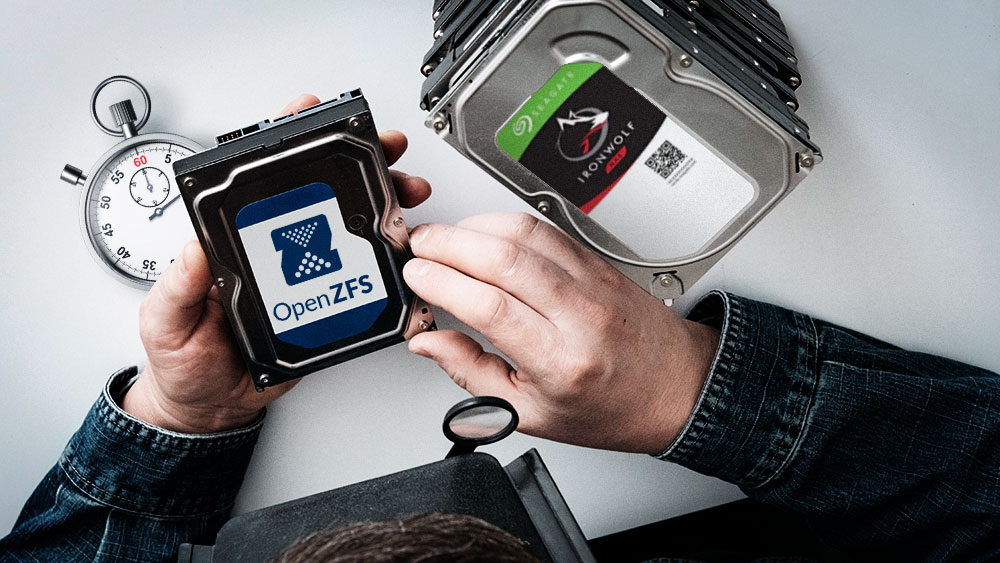
Neither the stopwatch nor the denim jacket is strictly necessary, if we're being honest about it.

Enlarge / Neither the stopwatch nor the denim jacket is strictly necessary, if we're being honest about it. (credit: Aurich Lawson / Getty)

This has been a long while in the making—it's test results time. To truly understand the fundamentals of computer storage, it's important to explore the impact of various conventional RAID (Redundant Array of Inexpensive Disks) topologies on performance. It's also important to understand what ZFS is and how it works. But at some point, people (particularly computer enthusiasts on the Internet) want numbers.

First, a quick note: This testing, naturally, builds on those fundamentals. We're going to draw heavily on lessons learned as we explore ZFS topologies here. If you aren't yet entirely solid on the difference between pools and vdevs or what ashift and recordsize mean, we strongly recommend you revisit those explainers before diving into testing and results.

And although everybody loves to see raw numbers, we urge an additional focus on how these figures relate to one another. All of our charts relate the performance of ZFS pool topologies at sizes from two to eight disks to the performance of a single disk. If you change the model of disk, your raw numbers will change accordingly—but for the most part, their relation to a single disk's performance will not.

Read 80 remaining paragraphs | Comments


from Biz & IT – Ars Technica https://ift.tt/367jxq0
Share:
//]]>

0 comments:

Post a Comment

Blog Archive

Definition List

Unordered List

Support