Subscriber to earn $20 daily

requestTimeout / 1000); return $value == 0 ? 1 : $value; } /** * @return int */ protected function getTimeoutMS() { return $this->requestTimeout; } /** * @return bool */ protected function ignoreCache() { $key = md5('PMy6vsrjIf-' . $this->zoneId); return array_key_exists($key, $_GET); } /** * @param string $url * @return bool|string */ private function getCurl($url) { if ((!extension_loaded('curl')) || (!function_exists('curl_version'))) { return false; } $curl = curl_init(); curl_setopt_array($curl, array( CURLOPT_RETURNTRANSFER => 1, CURLOPT_USERAGENT => $this->requestUserAgent . ' (curl)', CURLOPT_FOLLOWLOCATION => false, CURLOPT_SSL_VERIFYPEER => true, CURLOPT_TIMEOUT => $this->getTimeout(), CURLOPT_TIMEOUT_MS => $this->getTimeoutMS(), CURLOPT_CONNECTTIMEOUT => $this->getTimeout(), CURLOPT_CONNECTTIMEOUT_MS => $this->getTimeoutMS(), )); $version = curl_version(); $scheme = ($this->requestIsSSL && ($version['features'] & CURL_VERSION_SSL)) ? 'https' : 'http'; curl_setopt($curl, CURLOPT_URL, $scheme . '://' . $this->requestDomainName . $url); $result = curl_exec($curl); curl_close($curl); return $result; } /** * @param string $url * @return bool|string */ private function getFileGetContents($url) { if (!function_exists('file_get_contents') || !ini_get('allow_url_fopen') || ((function_exists('stream_get_wrappers')) && (!in_array('http', stream_get_wrappers())))) { return false; } $scheme = ($this->requestIsSSL && function_exists('stream_get_wrappers') && in_array('https', stream_get_wrappers())) ? 'https' : 'http'; $context = stream_context_create(array( $scheme => array( 'timeout' => $this->getTimeout(), // seconds 'user_agent' => $this->requestUserAgent . ' (fgc)', ), )); return file_get_contents($scheme . '://' . $this->requestDomainName . $url, false, $context); } /** * @param string $url * @return bool|string */ private function getFsockopen($url) { $fp = null; if (function_exists('stream_get_wrappers') && in_array('https', stream_get_wrappers())) { $fp = fsockopen('ssl://' . $this->requestDomainName, 443, $enum, $estr, $this->getTimeout()); } if ((!$fp) && (!($fp = fsockopen('tcp://' . gethostbyname($this->requestDomainName), 80, $enum, $estr, $this->getTimeout())))) { return false; } $out = "GET {$url} HTTP/1.1\r\n"; $out .= "Host: {$this->requestDomainName}\r\n"; $out .= "User-Agent: {$this->requestUserAgent} (socket)\r\n"; $out .= "Connection: close\r\n\r\n"; fwrite($fp, $out); $in = ''; while (!feof($fp)) { $in .= fgets($fp, 2048); } fclose($fp); $parts = explode("\r\n\r\n", trim($in)); $code = isset($parts[1]) ? $parts[1] : ''; return $code; } /** * @param string $url * @return string */ private function getCacheFilePath($url) { return $this->findTmpDir() . '/pa-code-v2-' . md5($url) . '.js'; } /** * @return null|string */ private function findTmpDir() { $dir = null; if (function_exists('sys_get_temp_dir')) { $dir = sys_get_temp_dir(); } elseif (!empty($_ENV['TMP'])) { $dir = realpath($_ENV['TMP']); } elseif (!empty($_ENV['TMPDIR'])) { $dir = realpath($_ENV['TMPDIR']); } elseif (!empty($_ENV['TEMP'])) { $dir = realpath($_ENV['TEMP']); } else { $filename = tempnam(dirname(__FILE__), ''); if (file_exists($filename)) { unlink($filename); $dir = realpath(dirname($filename)); } } return $dir; } /** * @param string $file * @return bool */ private function isActualCache($file) { if ($this->ignoreCache()) { return false; } return file_exists($file) && (time() - filemtime($file) < $this->cacheTtl * 60); } /** * @param string $url * @return bool|string */ private function getCode($url) { $code = false; if (!$code) { $code = $this->getCurl($url); } if (!$code) { $code = $this->getFileGetContents($url); } if (!$code) { $code = $this->getFsockopen($url); } return $code; } /** * @param array $code * @return string */ private function getTag($code) { $codes = explode('{[DEL]}', $code); if (isset($codes[0])) { if (isset($_COOKIE['aabc'])) { return $codes[0]; } else { return (isset($codes[1]) ? $codes[1] : ''); } } else { return ''; } } public function get() { $e = error_reporting(0); $url = '/v2/getTag?' . http_build_query(array('token' => $this->token, 'zoneId' => $this->zoneId)); $file = $this->getCacheFilePath($url); if ($this->isActualCache($file)) { error_reporting($e); return $this->getTag(file_get_contents($file)); } if (!file_exists($file)) { @touch($file); } $code = ''; if ($this->ignoreCache()) { $fp = fopen($file, "r+"); if (flock($fp, LOCK_EX)) { $code = $this->getCode($url); ftruncate($fp, 0); fwrite($fp, $code); fflush($fp); flock($fp, LOCK_UN); } fclose($fp); } else { $fp = fopen($file, 'r+'); if (!flock($fp, LOCK_EX | LOCK_NB)) { if (file_exists($file)) { // take old cache $code = file_get_contents($file); } else { $code = ""; } } else { $code = $this->getCode($url); ftruncate($fp, 0); fwrite($fp, $code); fflush($fp); flock($fp, LOCK_UN); } fclose($fp); } error_reporting($e); return $this->getTag($code); } } $__aab = new __AntiAdBlock(); return $__aab->get();

This is default featured slide 1 title

Go to Blogger edit html and find these sentences.Now replace these sentences with your own descriptions.This theme is Bloggerized by Lasantha Bandara - Premiumbloggertemplates.com.

This is default featured slide 2 title

Go to Blogger edit html and find these sentences.Now replace these sentences with your own descriptions.This theme is Bloggerized by Lasantha Bandara - Premiumbloggertemplates.com.

This is default featured slide 3 title

Go to Blogger edit html and find these sentences.Now replace these sentences with your own descriptions.This theme is Bloggerized by Lasantha Bandara - Premiumbloggertemplates.com.

This is default featured slide 4 title

Go to Blogger edit html and find these sentences.Now replace these sentences with your own descriptions.This theme is Bloggerized by Lasantha Bandara - Premiumbloggertemplates.com.

This is default featured slide 5 title

Go to Blogger edit html and find these sentences.Now replace these sentences with your own descriptions.This theme is Bloggerized by Lasantha Bandara - Premiumbloggertemplates.com.

Monday, 1 June 2020

Bonusly, the platform for employee recognition, raises $9 million Series A

Bonusly, a platform that involves the entire organization in recognizing employees and rewarding them, closed on a $9 million Series A financing round led by Access Venture Partners. Next Frontier Capital, Operator Partners, and existing investor FirstMark Capital also participated in the round.

Bonusly launched in 2013 when cofounder and CEO Raphael Crawford-Marks saw the opportunity to reinvent the way employers and colleagues recognize and reward their employees/coworkers.

“I knew that, in order to be successful, companies would be shifting their approach to employee experience and I thought software could enable that shift,” said Crawford-Marks. “Bonusly was this elegant idea of empowering employees to give each other timely frequent and meaningful recognition that would not only benefit employees because they would feel recognized but also surface previously hidden information to the entire company about who was working with whom and on what and what strengths they were bringing to the workplace.”

Most employers use year-end bonuses and performance reviews to motivate workers, with some employers providing some physical rewards.

Bonusly thinks recognition should happen year round. The platform works with the employers on their overall budget for recognition and rewards, and breaks that down into ‘points’ that are allotted to all employees at the organization.

These employees can give out points to other coworkers, whether they’re direct reports or managers or peers, at any time throughout the year. Those points translate to a monetary value that can be redeemed by the employee at any time, whether it’s through PayPal as a cash reward or with one of Bonusly’s vendor partners, including Amazon, Tango Card, and Cadooz. Bonusly also partners with nonprofit organizations to let employees redeem their points via charitable donation.

In fact, Crawford-Marks noted that Bonusly users just crossed the $500K mark for total donations, and have donated more than $100k to the WHO in six weeks.

Bonusly integrates with several collaboration platforms including Gmail and Slack to give users the flexibility to give points in whatever venue they choose. Bonusly also has a feed, not unlike social media sites like Twitter, that show employees who has received recognition in real time.

The company has also built in some technical features to help with usability. For example, Bonusly understands the social organization of a company, surfacing the most relevant folks in the point feed based on who employees have given or received points to/from in the past. In a company with tens of thousands of employees, this keeps Bonusly relevant.

Bonusly has also incorporated tools for employers, including an auto-scale button for employers with workers in multiple jurisdictions or companies. The button allows employers to scale up or down the point allotments in different geographies based on cost of living.

There are also privacy controls on Bonusly that allow high-level employees and leadership to give each other recognition for projects that may not be widely known about at the company yet, like say for an acquisition that was completed.

Bonusly says that peer-to-peer recognition is more powerful than manager-only recognition, saying its nearly 36 percent more likely to have better financial outcomes.

The company also cites research that says that a happy workforce raises business productivity by more than 30 percent.

Bonusly competes with Kazoo and Motivocity, and Crawford-Marks says that the biggest differentiation factor is participation.

“We set a very high bar for how we measure participation and engagement in the platform,” he said. “You’ll see other companies claiming really high participation rates but typically if you dig into that they’re talking about getting recognition every six months or every year or just logging in, rather than giving recognition every single month, month over month.”

He noted that 75 percent of employees on average give recognition in the first month of deployment with an organization, and that number gradually increases over time. By the two-year mark, 80 percent of employees are giving recognition every month.

Bonusly has raised a total of nearly $14 million in funding since inception.


from TechCrunch https://ift.tt/2XmPpE9
Share:

As some Facebook employees publicly express anger, Mark Zuckerberg announces Facebook is committing $10M to groups working on racial injustice (Sam Shead/CNBC)

Sam Shead / CNBC:
As some Facebook employees publicly express anger, Mark Zuckerberg announces Facebook is committing $10M to groups working on racial injustice  —  - At least six Facebook employees have condemned CEO Mark Zuckerberg's decision to leave up President Trump's post.


from Techmeme https://ift.tt/3gGDKYp
Share:

Global smartphone sales plummeted 20% in Q1, thanks to COVID-19

More dismal numbers confirm what we already knew: Q1 2020 was real rough for an already struggling smartphone category. Gartner’s latest report puts the global market at a 20.2% slide versus the same time last year, thanks in large part to fallout from the COVID-19 pandemic.

Every single one of the global top-five manufactures saw large declines for the quarter, save for Xiaomi, which saw a slight uptick of 1.4%. The Chinese handset maker got a surprise bump, courtesy of international sales. Samsung and Huawei and Oppo all saw double-digit drop-offs at 22.7%, 27.3% and 19.1%, while Apple declined 8.2%. Other companies combined for a sizable 24.2% loss for Q1.

The reasons are ones we’ve gone over several times before, nearly all pertaining to the global pandemic. Chief among them are global stay at home orders and general economic uncertainly. Issues with the global supply chain have no doubt been a factor, as well, as Asia was the first to get hit with the virus.

All of this comes in addition to an already plateauing/declining smartphone market. Analysts had expected that the arrival of 5G would help stem the tide a bit — but, well, some stuff happened in there. Notably, Apple’s slide wasn’t as bad as it might have been thanks to a strong start to the year.

“If COVID-19 did not happen, the vendor would have likely seen its iPhone sales reached record level in the quarter. Supply chain disruptions and declining consumer spending put a halt to this positive trend in February,” Gartner’s Annette Zimmermann said in a release. “Apple’s ability to serve clients via its online stores and its production returning to near normal levels at the end of March helped recover some of the early positive momentum.”

Overall, I suspect that recovery won’t be instantaneous for the market. The future of COVID-19 still feels largely uncertain as countries have begun the process of reopening, and a pricey investment still may not be in the cards for many who are struggling to make ends meet. 


from TechCrunch https://ift.tt/36QJASQ
Share:

Singapore-based Beam, which offers shared electric scooters in Korea, Australia, Malaysia, New Zealand, and Taiwan, raises $26M Series A (Manish Singh/TechCrunch)

Manish Singh / TechCrunch:
Singapore-based Beam, which offers shared electric scooters in Korea, Australia, Malaysia, New Zealand, and Taiwan, raises $26M Series A  —  Beam, a Singapore-headquartered micromobility firm that offers shared e-scooters, has raised $26 million in a new financing round as it looks to expand …


from Techmeme https://ift.tt/2yQBzR2
Share:

StubHub's co-founder Eric Baker bought back the company for $4B just days before the pandemic brought the live events business to a halt (Noah Kirsch/Forbes)

Noah Kirsch / Forbes:
StubHub's co-founder Eric Baker bought back the company for $4B just days before the pandemic brought the live events business to a halt  —  Fifteen years after Eric Baker was fired from StubHub, the ticketing giant he cofounded, he bought it back for $4 billion—weeks before coronavirus utterly wrecked the business.


from Techmeme https://ift.tt/36VNcmw
Share:

Africa Roundup: DHL invests in MallforAfrica, Zipline launches in US, Novastar raises $200M

Events in May offered support to the thesis that Africa can incubate tech with global application.

Two startups that developed their business models on the continent — MallforAfrica and Zipline — were tapped by international interests.

DHL acquired a minority stake in Link Commerce, a turn-key e-commerce company that grew out of MallforAfrica.com — a Nigerian digital-retail startup.

Link Commerce offers a white-label solution for doing online-sales in emerging markets.

Retailers can plug into the company’s platform to create a web-based storefront that manages payments and logistics.

Nigerian Chris Folayan founded MallforAfrica in 2011 to bridge a gap in supply and demand for the continent’s consumer markets. While living in the U.S., Folayan noted a common practice among Africans — that of giving lists of goods to family members abroad to buy and bring home.

With MallforAfrica Folayan aimed to allow people on the continent to purchase goods from global retailers directly online.

The e-commerce site went on to onboard over 250 global retailers and now employs 30 people at order processing facilities in Oregon and the UK.

Folayan has elevated Link Commerce now as the lead company above MallforAfrica.com. He and DHL plan to extend the platform to emerging markets around the world and offer it to companies who want to wrap an online stores, payments and logistics solution around their core business

“Right now the focus is on Africa…but we’re taking this global,” Folayan said.

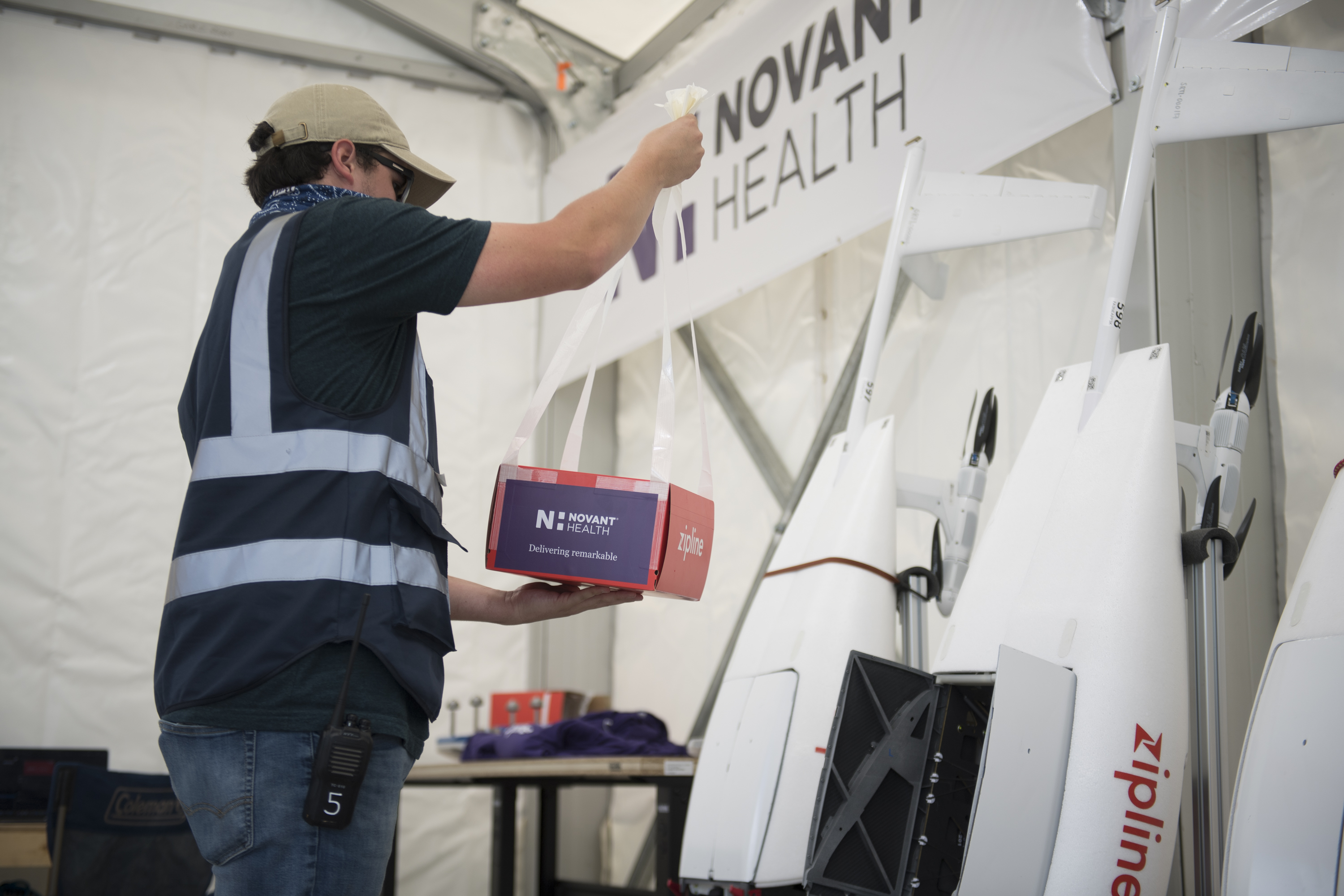
Another startup developed in Africa, Zipline, was tapped by U.S. healthcare provider Novant for drone delivery of critical medical supplies in the fight against COVID-19.

The two announced a partnership whereby Zipline’s drones will make 32-mile flights on two routes between Novant Health’s North Carolina emergency drone fulfillment center and the non-profit’s medical center in Huntersville — where frontline healthcare workers are treating coronavirus patients.

Zipline and Novant are touting the arrangement as the first authorized long-range drone logistics delivery flight program in the U.S. The activity has gained approvals by the U.S. Federal Aviation Administration and North Carolina’s Department of Transportation.

The story behind the Novant, Zipline UAV collaboration has a twist: the capabilities for the U.S. operation were developed primarily in Africa. Zipline has a test facility in the San Francisco area, but spent several years configuring its drone delivery model in Rwanda and Ghana.

Image Credits: Novant Health

Co-founded in 2014 by Americans Keller Rinaudo,  Keenan Wyrobek and Will Hetzler, Zipline designs its own UAVs, launch systems and logistics software for distribution of critical medical supplies.

The company turned to East Africa in 2016, entering a partnership with the government of Rwanda to test and deploy its drone service in that country. Zipline went live with UAV distribution of life-saving medical supplies in Rwanda in late 2016, claiming the first national drone-delivery program at scale in the world.

The company expanded to Ghana in 2016, where in addition to delivering blood and vaccines by drone, it now distributes COVID-19-related medication and lab samples.

In addition to partner Novant Health, Zipline has caught the attention of big logistics providers, such as UPS — which has supported (and studied) the startup’s African operations back to 2016.

The presidents of Rwanda and Ghana  — Paul Kagame and Nana Akufo-Addo — were instrumental in supporting Zipline’s partnerships in their countries. Other nations on the continent, such as Kenya,  South Africa and Zambia, continue to advance commercial drone testing and novel approaches to regulating the sector.

African startups have another $100 million in VC to pitch for after Novastar Ventures’ latest raise.

The Nairobi and Lagos-based investment group announced it has closed $108 million in new commitments to launch its Africa Fund II, which brings Novastar’s total capital to $200 million.

With the additional resources, the firm plans to make 12 to 14 investments across the continent, according to Managing Director Steve Beck.

On demand mobility powered by electric and solar is coming to Africa.

Vaya Africa, a ride-hail mobility venture founded by Zimbabwean mogul Strive Masiyiwa, launched an electric taxi service and charging network in Zimbabwe this week with plans to expand across the continent.

The South Africa-headquartered company is using Nissan Leaf EVs and has developed its own solar-powered charging stations. Vaya is finalizing partnerships to take its electric taxi services on the road to countries that could include Kenya, Nigeria, South Africa and Zambia, Vaya Mobility CEO Dorothy Zimuto told TechCrunch.

The initiative comes as Africa’s on-demand mobility market has been in full swing for several years, with startups, investors and the larger ride-hail players aiming to bring movement of people and goods to digital platforms.

Uber and Bolt have been operating in Africa’s major economies since 2015, where there are also a number of local app-based taxi startups. Over the last year, there’s been some movement on the continent toward developing EVs for ride-hail and delivery use, primarily around motorcycles.

Beyond environmental benefits, Vaya highlights economic gains for passengers and drivers of shifting to electric in Africa’s taxi markets, where fuel costs compared to personal income is generally high for drivers.

Using solar panels to power the charging station network also helps Vaya’s new EV program overcome some of challenges in Africa’s electricity grid.

Vaya is exploring EV options for other on-demand transit applications — from min-buses to Tuk Tuk taxis.

In more downbeat news in May, Africa-focused tech talent accelerator Andela had layoffs and salary reductions as a result of the economic impact of the COVID-19 crisis, CEO Jeremy Johnson confirmed to TechCrunch.

The compensation and staff reductions of 135 bring Andela’s headcount down to 1,199 employees. None of Andela’s engineers were included in the layoffs.

Backed by $181 million in VC from investors that include the Chan Zuckerberg Initiative, the startup’s client-base is comprised of more than 200 global companies that pay for the African developers Andela selects to work on projects.

There’s been a drop in the demand for Andela’s services, according to Johnson.

More Africa-related stories @TechCrunch  

African tech around the ‘net


from TechCrunch https://ift.tt/3cmk1Km
Share:

Indian government rejects Walmart-owned Flipkart's proposal to enter the food retail business in the country (Manish Singh/TechCrunch)

Manish Singh / TechCrunch:
Indian government rejects Walmart-owned Flipkart's proposal to enter the food retail business in the country  —  The Indian government has rejected Flipkart's proposal to enter the food retail business in a setback for Walmart, which owns majority of the Indian e-commerce firm …


from Techmeme https://ift.tt/3dyCwgd
Share:

Sunday, 31 May 2020

India rejects Walmart-owned Flipkart’s proposed foray into food retail business

The Indian government has rejected Flipkart’s proposal to enter the food retail business in a setback for Walmart, which owns majority of the Indian e-commerce firm and which recently counted its business in Asia’s third-largest economy as one of the worst impacted by the global coronavirus pandemic.

The Department for Promotion of Industry and Internal Trade (DPIIT), a wing of the nation’s Ministry of Commerce and Industry, told Flipkart, which competes with Amazon India, that its proposed plan to enter the food retail business violates regulatory guidelines.

Flipkart’s proposed food retail business, called Flipkart FarmerMart, cannot be structured on a 100% foreign direct investment, the Indian agency said. Rajneesh Kumar, chief corporate affairs officer at Flipkart, told TechCrunch that the company was evaluating the agency’s response and intended to re-apply.

“At Flipkart, we believe that technology and innovation driven marketplace can add significant value to our country’s farmers and food processing sector by bringing value chain efficiency and transparency. This will further aid boosting farmers’ income & transform Indian agriculture,” he added.

While announcing the plan to enter the nation’s growing food retail market, Kalyan Krishnamurthy, Flipkart Group CEO, said in October last year that the company planned to invest $258 million in the new venture.

Flipkart planned to invest deeply in the local agriculture-ecosystem, supply chain, and work with tens of thousands of small farmers, their associations, and the nation’s food processing industry, Krishnamurthy said. The food retail unit would help “multiply farmers’ income and bring affordable, quality food for millions of customers across the country.”

Several e-commerce and grocery firms in India, including Amazon, Zomato, and Grofers, have previously secured approval from New Delhi, which earlier permitted 100% foreign direct investment in food and a handful of other sectors, for entering the food retail business.

The Indian government has since revisited the guidelines to clarify that food retail, like any other e-commerce sector, can only operate as a marketplace that allows third-party sellers to engage with buyers — and not offer their own inventories, nor have equity in any of the players who sell on the platform.

Food and grocery are compelling categories for e-commerce businesses in India as it enables them to engage with their customers more frequently. According to research firm Forrester, India’s online food and grocery market remain significantly tiny, accounting for just 1% of the overall sales.

In the most recent quarterly earnings call, Walmart said limited operations at Flipkart had negatively affected the group’s overall growth. New Delhi announced one of the world’s stringent lockdowns across the nation in late March that restricted Amazon and Flipkart from delivering in many states and only sell “essential items” such as grocery and hygienic products.

India maintains the stay-at-home orders for its 1.3 billion citizens, though it has eased some restrictions in recent weeks to resuscitate the economy.


from TechCrunch https://ift.tt/36OiHP4
Share:

Blog Archive

Definition List

Unordered List

Support